

New Analysis Suggests Hemp Brands' Packaging Deadline Falls Weeks Before the December THC Cap
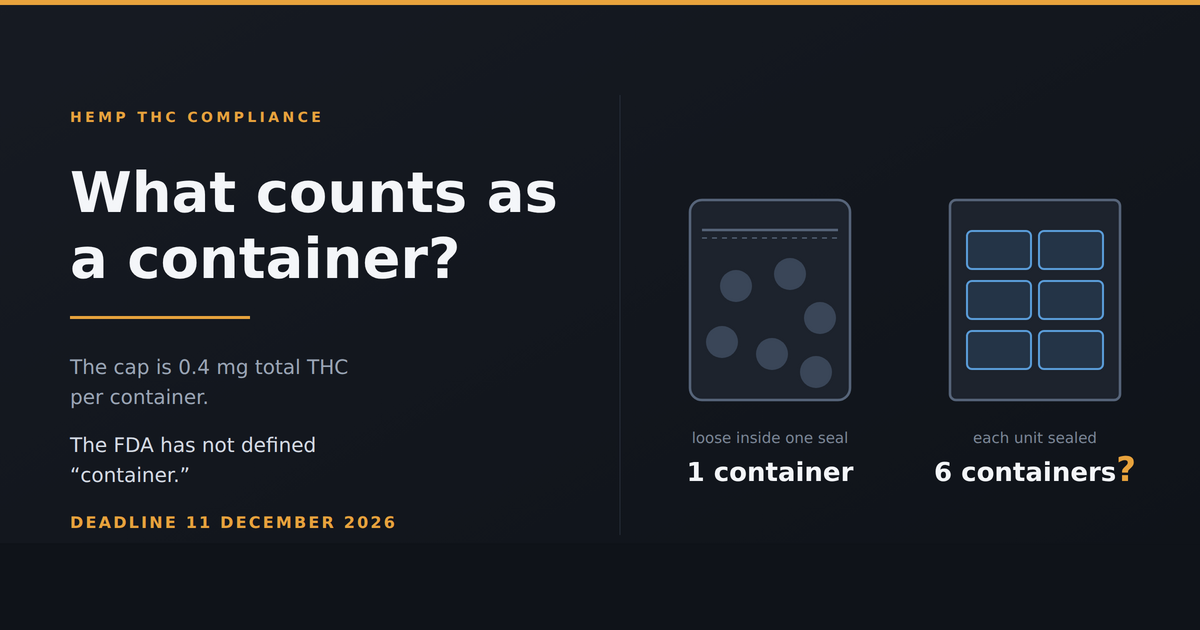
What Counts as a "Container" Under the 0.4 mg THC Cap?
Congress gave hemp brands 29 extra days. A packaging run takes four to six weeks even with a fast converter, and orders can legally arrive 20 per cent short.
GLENDALE, CA, UNITED STATES, October 6, 2026 /EINPresswire.com/ -- For most of the hemp industry, 11 December 2026 is the date that matters. That is when finished hemp products with more than 0.4 mg of total THC per container lose their federal hemp status. But new analysis from Black Unicorn Hub, a Glendale, California mylar bag and packaging supplier, suggests that for brands that must repackage, the practical deadline arrives weeks earlier.
The limit applies per container, not per serving, which turns a formulation problem into a packaging one. A single 5 mg gummy carries 12.5 times the limit. Federal law defines a container as the innermost wrapping, packaging or vessel in direct contact with a product, in which it is enclosed for retail sale. Congress also directed the FDA to publish more detail on the term, but that guidance had not appeared as of 3 September, according to Hemp Law Group. All figures in this release come from the company's detailed analysis of hemp packaging under the 0.4 mg cap, which applies that definition to eight common packaging formats and rates each one's risk.
The calendar is the first problem. Black Unicorn Hub's analysis breaks a run of custom printed mylar pouches into its stages: artwork revision, quoting, proofing, production and freight. One supplier publishes production times of 15 to 18 business days after proof approval. Add the stages either side, and a full cycle with a fast domestic converter takes four to six weeks. On that basis, 30 October is the last date to start a run that leaves room for one failed proof. Slower suppliers leave even less room. One supplier quotes eight to fourteen weeks from confirmed artwork to delivery, which would push the start date into mid-October.
The industry is already feeling that squeeze. "Nothing operates on a 29-day cycle," Upstate Elevator chief executive Dylan Raap told MJBizDaily in September, describing raw materials, co-packing and packaging that all need months of lead time.
The second problem is quantity. Custom pouch production carries a manufacturing tolerance, and one supplier publishes theirs at plus or minus 20 per cent. An order for 10,000 pouches can therefore arrive as 8,000, with no time left to reorder. To be sure of receiving 10,000, a brand would need to order about 12,500, which raises the quoted total by about 19 per cent.
The third problem is cost. The analysis estimates that repackaging a single product on rotogravure costs $3,345 to $5,325 before design work, legal review or writing off existing stock. For a brand with twenty products, writing off old packaging alone could come to $50,000 to $80,000.
The format a product ships in also matters. A resealable pouch of loose gummies counts as a single container, so ten loose 0.4 mg gummies add up to 4 mg, ten times the limit. Individually sealed sachets inside a carton are more defensible, because each sachet is the innermost packaging in contact with the product. That position is still open to challenge until the FDA publishes its guidance.
"Everyone is watching 11 December, but for packaging, the date that matters is the last day you can start a production run," said Roshan Timsina, Head of Marketing at Black Unicorn Hub. "A brand that waits for the FDA to finish defining 'container' may find the calendar has already made the decision for them."
The stakes are large. Whitney Economics estimates the hemp sector at $38.7 billion in annual sales, supporting roughly 225,000 US jobs, according to MJBizDaily.
Black Unicorn Hub has published its full analysis, including cost tables, sources and an update log, on its website. The company sells packaging and discloses that commercial interest in the analysis, which is not legal advice.
About Black Unicorn Hub
Black Unicorn Hub, operated by Mylar Packaging Inc. and based in Glendale, California, supplies empty mylar bags, glass jars and premium packaging to retailers and distributors, and offers custom printed mylar bags made to order from customer artwork.
Roshan Timsina
Black Unicorn Hub
info.roshantimsina@gmail.com
Legal Disclaimer:
EIN Presswire provides this news content "as is" without warranty of any kind. We do not accept any responsibility or liability for the accuracy, content, images, videos, licenses, completeness, legality, or reliability of the information contained in this article. If you have any complaints or copyright issues related to this article, kindly contact the author above.
